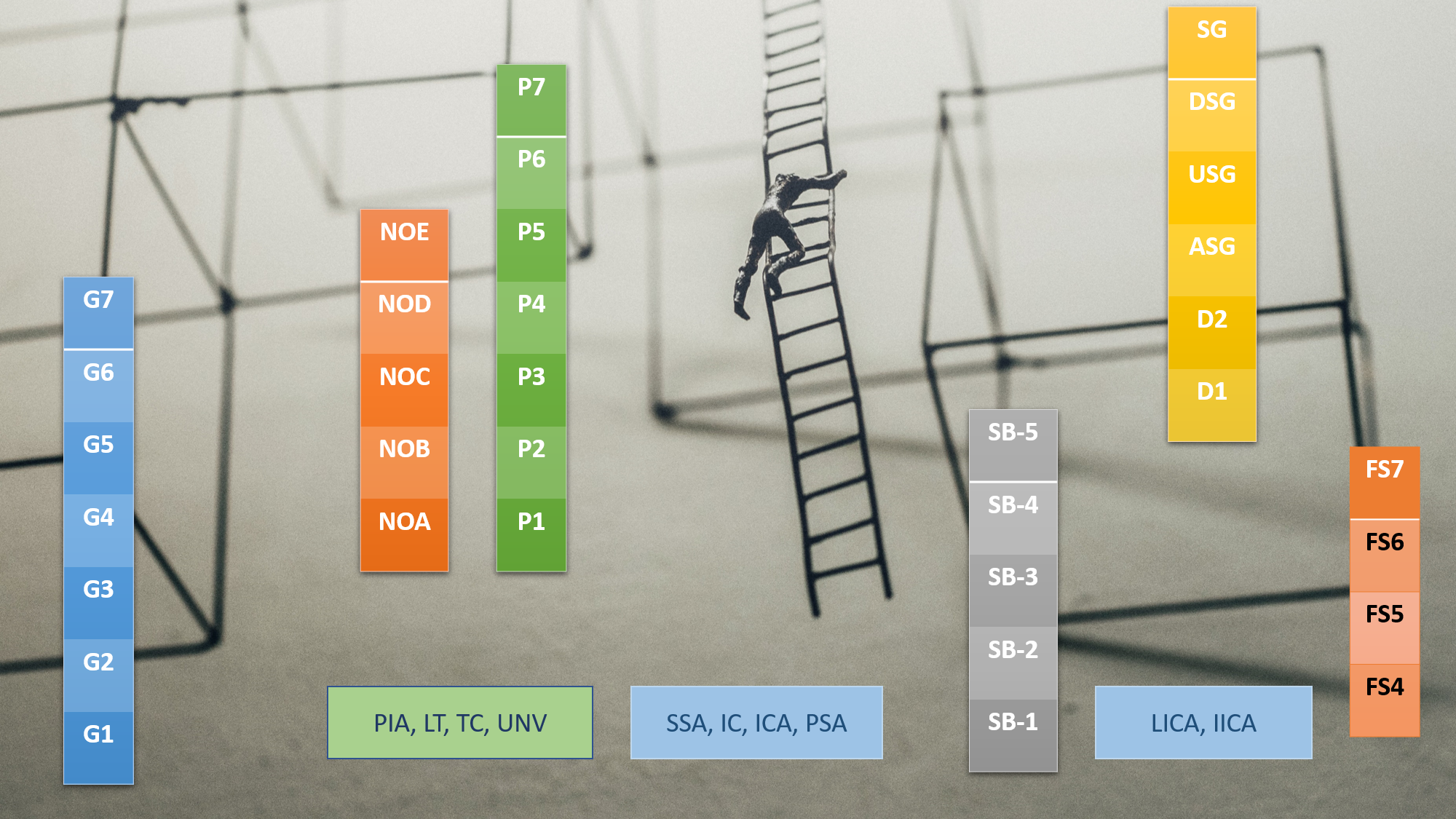
Every UN vacancy notice carries a line that applicants tend to read last: the contract type. It may say fixed-term appointment, temporary appointment, individual contractor, IPSA-10, special service agreement or UN Volunteer. That line is not administrative detail. It governs pension participation, health coverage, field entitlements and access to the internal justice system — more decisively than either the grade or the headline figure attached to the post.
The instinctive question is which contract type is best. The more useful question is narrower: does the modality confer staff status? Almost every other difference in the system follows from that single classification, and reading a vacancy notice with that question in mind turns a wall of acronyms into a short and manageable set of distinctions.
- The system has three staff appointments — temporary, fixed-term and continuing — alongside a larger family of non-staff arrangements: consultancies and individual contracts, UNDP’s IPSA and NPSA, UNOPS’s LICA and IICA, special service agreements, and UN Volunteer assignments.
- Staff status is what attaches an appointment to the common-system machinery: pension fund participation, post adjustment, dependency and field entitlements, and standing before the UN Tribunals. Non-staff modalities carry their own, usually simpler, packages.
- No fixed-term appointment carries a promise of renewal. The Staff Rules state this expressly, and planning on that basis is what makes a career in the system navigable.
- Non-staff service does not convert into a staff post by accumulation. The route to staff status runs through open competition — a well-defined and winnable process.
The written guide below explains the rules. UNjobnet’s contract fingerprints show them: every modality scored across eight dimensions — pension, leave, health cover, family entitlements, relocation, job security, legal recourse and career progression — and drawn as a shape that can be laid over another for comparison. The benefit-by-benefit detail behind those scores is in the benefits and allowances table.
The line that actually matters: staff or non-staff
The UN common system draws a firm boundary. A staff member is appointed under the Staff Regulations and Rules of the organization — a body of law setting out pay, leave, allowances, discipline and separation, and conferring standing before the UN Dispute Tribunal and the Appeals Tribunal. Non-staff personnel are engaged under a commercial-style contract and, in the wording the contracts themselves use, are not regarded as staff members. Their disputes are settled amicably or, failing that, by arbitration under the UNCITRAL rules rather than by the Tribunals.1
That boundary explains why a headline consultancy fee can be worth less in total than a lower-graded staff appointment. The staff appointment carries participation in the UN Joint Staff Pension Fund, organization-subsidized health insurance and, where the duty station warrants it, the entitlements that make field service sustainable. The consultancy carries the fee. Scored across the eight dimensions used in the consultant fingerprint, a consultancy reaches about 8 per cent of the density of a full staff package, against 96 per cent for a fixed-term appointment — an editorial reading of published entitlements rather than an official index, but the gap it describes is real and rarely visible in the fee.
Why there are exactly three staff appointments
The number is not arbitrary. The General Assembly’s contractual reform of 2009 replaced an accumulated tangle of appointment types with a deliberate set of three — temporary, fixed-term and continuing — and ended the practice of holding long-serving personnel indefinitely on short-term arrangements.2
What the reform did not touch matters just as much. The staff side was consolidated once and has stayed legible ever since; the non-staff side was never harmonized in the same way, and each organization went on building its own vocabulary on top of it. That asymmetry is the whole reason the staff appointments can be set out in three words while the non-staff modalities need a section of their own — and why the acronyms multiply on one side of the line and not the other.
The three staff appointments
A temporary appointment (TA) is granted for less than a year to cover seasonal peaks, surge demands and short-term requirements, renewable by up to one further year where field operations and special projects justify it. Two features are routinely misunderstood. The Staff Rules provide that a temporary appointment “shall not be converted to any other type of appointment”; it expires on its stated date.1 It does, however, confer full staff status for its duration, and it can bring the holder into the Pension Fund. Participation attaches either to an appointment of six months or more, or to the completion of six months of service without an interruption of more than 30 days — so a short temporary appointment that is extended reaches the Fund by the second route even though it did not qualify on the first.3
A fixed-term appointment (FTA) is the workhorse of the system: at least one year, up to five at a time, renewable, covering work that forms part of the organization’s regular and continuing activity. It carries the full staff package. What it does not carry is an assurance of continuation. The Staff Rules provide that a fixed-term appointment “does not carry any expectancy, legal or otherwise, of renewal or conversion, irrespective of the length of service”.1 The clause is explicit because renewal follows the funding of the post, which is a budgetary question rather than a judgement on the holder.
A continuing appointment is open-ended, and is the closest equivalent to permanency in the modern system. It is neither automatic nor abundant: eligibility generally requires five years of continuous service, satisfactory performance across most of that period, a clean disciplinary record and sufficient time before mandatory retirement, and the number granted each year is set against the organization’s continuing needs.4 One route is both faster and firmer. Staff members recruited in the Professional category through a competitive examination — in practice the Young Professionals Programme — shall be granted a continuing appointment after two years on a fixed-term appointment, subject to satisfactory service.1 The wording is mandatory rather than discretionary, and it is among the least-discussed reasons the YPP repays the effort it demands.
The non-staff modalities, agency by agency
Here the vocabulary fragments, and two vacancies that appear to offer materially different arrangements often differ only in the house style of the agency advertising them.
In the UN Secretariat, the instruments are the consultant and the individual contractor, governed by a single administrative instruction, revised in January 2025. A consultant is engaged for expertise not available in-house; an individual contractor for work of a more operational character. Both are capped: no individual may provide services for more than 24 months in any 36-month period, whether or not those months run consecutively.5 The ceiling is the system’s deliberate safeguard against permanent-contractor drift, and it rewards forward planning — an engagement approaching the limit calls for a defined next step rather than an assumed extension.
UNDP retired its former Individual Contract and Service Contract in favour of two personnel services agreements: the IPSA for internationally recruited personnel and the NPSA for nationally recruited personnel, with the transition completed on 31 March 2022 and individual contracts retained only for lump-sum, deliverable-based work.6 IPSA and NPSA holders are described as affiliate personnel rather than staff. The agreements are issued for defined periods, renewable within a ceiling, and carry a benefits package — leave and insurance arrangements — that is substantial without being the staff package, and that does not include the Pension Fund. NPSA holders instead receive a lump sum equivalent to 8.33 per cent of pay in lieu of pension and other social-security obligations, and a later revision of the IPSA policy added annual remuneration increments and a pension contribution for regular IPSA holders — neither of which is UNJSPF participation. An advertised level such as IPSA-10 denotes a UNDP contract level rather than a UN grade, and is not interchangeable with P-3 even where the responsibilities are comparable.
UNOPS uses the Individual Contractor Agreement, split into local (LICA) and international (IICA) variants, sometimes on a retainer basis under which the organization commits to a volume of work in exchange for a commitment of availability.7 WHO, PAHO and WFP, among others, continue to use the special service agreement (SSA) alongside consultant contracts, while FAO engages most of its non-staff personnel under a personal services agreement (PSA). Different letters, the same legal category.
UN Volunteer assignments sit apart again. UN Volunteers are explicitly not staff members and are not covered by the Staff Regulations and Rules. They receive a volunteer living allowance and, depending on the assignment, family allowance, entry and exit lump sums and a hardship and danger differential — framed throughout as contributions to living costs rather than as salary.8 That framing is literal rather than euphemistic: the allowance is structured for a different purpose than pay, and warrants its own budgeting. Service is also finite by design — a maximum of four years in international UN Volunteer assignments, irrespective of time served under other volunteer modalities. The assignment nonetheless remains one of the most dependable routes into the system for candidates not yet positioned to compete for P-level posts.
JPO and secondment: not separate contract types
The Junior Professional Officer arrangement is not a distinct contract type. A JPO is a staff member on a fixed-term appointment, usually at the P-2 level, whose post is funded by a sponsoring government rather than by the host agency’s core budget — typically an initial year renewed to a second, and sometimes a third, with the donor’s agreement.9 The practical consequence at application stage is that eligibility is gated by nationality: applications go to the sponsoring government’s own programme rather than to the UN, and a small number of donors extend their schemes to nationals of developing countries.
Secondment is likewise a movement between organizations rather than a contract, governed by an inter-organization agreement that also covers transfer and loan.10 The distinctions repay attention before an inter-agency move is accepted. Under a secondment, normally for a fixed period of up to two years, the staff member is paid by and subject to the rules of the receiving organization while retaining employment rights with the releasing one. Under a transfer, no such return right survives: the relationship with the releasing organization ends. A loan is the arrangement under which the releasing organization continues to pay. Because the three terms are often used loosely in conversation, the operative one is worth confirming in the written offer.
What each contract actually confers
The table below is the short version; each modality links to its fingerprint, where the same package is scored dimension by dimension. The pension column follows directly from staff status; the duration column states ceilings rather than commitments.
| Modality | Staff member? | Typical duration | UNJSPF pension |
|---|---|---|---|
| Temporary appointment (TA) | Yes | Under one year; renewable by up to one more year for field surge | Yes, on an appointment of six months or longer — or once six months’ service is completed |
| Fixed-term appointment (FTA) | Yes | One to five years, renewable | Yes |
| Continuing appointment | Yes | Open-ended | Yes |
| JPO | Yes — a donor-funded fixed-term appointment | Around two years, sometimes extended to three | Yes |
| Consultant / individual contractor | No | No more than 24 months in any 36 | No |
| IPSA / NPSA (UNDP) | No — “affiliate personnel” | Up to a year at a time, renewable within a ceiling | No |
| LICA / IICA (UNOPS) | No | Assignment-based, renewable | No — a Provident Fund instead |
| UN Volunteer | No | Usually six to twelve months, renewable to four years in total | No |
The entitlements that make a demanding posting sustainable follow the same logic. Post adjustment, which corrects base salary for the cost of living at the duty station, applies to internationally recruited staff, as do the field entitlements — the hardship element tied to a duty station’s A-to-E classification, rest and recuperation cycles, and the rental subsidy that offsets housing costs at expensive locations. Daily subsistence allowance is the instructive exception: it is travel-related and payable to non-staff personnel on official travel where the contract so provides, because it reimburses a cost rather than recognizing a status. Where a single allowance is the question — whether a temporary appointment attracts the education grant, whether an affiliate contract carries danger pay — the benefits and allowances table sets out all thirty of them against every contract type.
Misconceptions and clarifications
That a fixed-term appointment will be renewed on the strength of good performance. Performance is necessary but not sufficient; renewal depends on the post continuing to exist and to be funded. The explicit denial of any expectancy is the most consequential sentence in the appointment framework, and taking it at face value allows for planning well ahead of an expiry date.
That sustained consultancy work leads to conversion. It does not. Non-staff service does not accumulate into staff status, and the 24-months-in-36 ceiling exists to prevent that pattern forming. The route from consultancy to a staff post runs through an advertised vacancy and open competition — a clearer and more tractable problem, covered in moving from consultant to P-staff.
That a temporary appointment carries no benefits. A TA holder is a staff member, with the same medical, service-incurred and malicious-acts cover as any other, and reaches the Pension Fund on an appointment of six months or longer or on completing six months of service. What a temporary appointment does not carry is the long-horizon package: no home leave, no education grant, no mobility incentive, no repatriation grant, and annual leave accruing at 1.5 days a month rather than 2.5. Short temporary appointments are limited in the shape of the package, not excluded from the category.
That a continuing appointment is a guarantee for life. It is open-ended, which is a different proposition. Posts may still be abolished and continuing appointments terminated; holders simply rank highest in the order of retention when that occurs.
That contract levels map onto UN grades. Levels within a non-staff modality belong to that agency’s internal framework and bear no fixed relationship to the common-system grade structure. Direct comparison misleads at precisely the point an offer is being assessed.
Whether a non-staff role is worth accepting. Frequently it is. Such roles provide entry to the institution, to its working relationships and to its internal circulation lists, and a substantial share of recruitment is won by candidates already visible within the system. The two qualifications are to treat the role as valuable in its own right rather than as a probationary period for something else, and to account for the absent pension and insurance when weighing the total value of the offer — the arithmetic the contract fingerprints are designed to make visible.
A note on scope
This guide describes the UN Secretariat’s appointment types and the principal non-staff modalities used across the funds, programmes and specialized agencies. Rules vary: each agency issues its own staff regulations and its own instruments for non-staff engagement, and the World Bank, IMF and regional development banks sit outside the common system entirely. Durations, ceilings and benefit packages are revised periodically. The governing text in any individual case is the specific letter of appointment or contract, read against the issuing organization’s policy portal — UNDP’s POPP, UNHCR, UNICEF and WFP each publish theirs — and the applicable administrative instruction.
Key takeaways
- Staff status is the decisive term in any UN engagement: it determines pension participation, insurance, allowances and legal recourse more than grade or fee does.
- The three staff appointments are temporary (under a year), fixed-term (one to five years, renewable) and continuing (open-ended, generally earned after five years and limited in number).
- No fixed-term appointment promises renewal; renewal follows the funding of the post. The exception that runs the other way is the competitive examination, after which a continuing appointment is granted at two years rather than earned at five.
- The non-staff modalities differ largely in vocabulary — consultant, individual contractor, IPSA, NPSA, LICA, IICA, SSA and PSA occupy the same legal category under different agency labels.
- JPO is a donor-funded fixed-term appointment gated by nationality; secondment preserves return rights to the releasing organization, and transfer does not.
Related reading
- Contract fingerprints: every modality scored across eight dimensions
- Benefits and allowances: thirty entitlements against every contract type
- The UN Joint Staff Pension Fund: a complete guide
- UN post adjustment explained: the PAI, the multiplier and why two staff on the same grade take home different pay
- Negotiating a UN job offer: what is flexible and what is not
- Understanding UN hardship duty stations: A to E classifications
- The overlooked job market: how to pivot from consultant to P-staff
Contract type is the element of a UN offer most often skimmed at the outset and most often revisited later. The modality on the table is generally set by how the post is funded rather than by negotiation, but understanding precisely what it confers turns an opaque document into a firm basis for planning. Current UN and international vacancies on UNjobnet →
Sources
- United Nations, “Appointment and promotion” (Staff Rules 4.12–4.14), policy.un.org. ↩
- General Assembly resolution 63/250, Human resources management, undocs.org. ↩
- UNJSPF, “Participation” (Regulations, article 21(a)), unjspf.org. ↩
- United Nations HR Portal, “Who is eligible for a continuing appointment?”, hr.un.org; General Assembly resolution 65/247, undocs.org. ↩
- ST/AI/2013/4/Rev.1, Consultants and individual contractors (17 January 2025), section 5.8, docs.un.org. ↩
- UNDP POPP, International Personnel Services Agreement and National Personnel Services Agreement, popp.undp.org. ↩
- UNOPS, Terms and conditions of the Individual Contractor Agreement, unops.org. ↩
- UNV, Unified Conditions of Service for UN Volunteers, unv.org. ↩
- UN Junior Professional Officer Programme, jpo.desa.un.org. ↩
- UN System Chief Executives Board, Inter-organization agreement concerning transfer, secondment or loan of staff, unsceb.org. ↩
Last reviewed: August 2026. This guide is general information rather than official HR or financial advice — entitlements should be confirmed with the employing organization’s HR and the governing UN instructions.