Equivalence claims circulate widely in the international employment market. A recruiter describes a post as “broadly a P-4 level”; a comparison site sets a World Bank GG alongside an EU AD 12; a candidate moving between institutions is told that a grade will be honoured. Such statements are inferences. No competent authority — not the International Civil Service Commission, not the European Commission, not the World Bank Group — publishes an equivalence table between the grade structures of different international organizations.
The reason is structural rather than administrative. A grade is not a rank held by an individual and carried between employers. It is a position within one organization's job classification system, attached to one pay structure, governed by one set of rules on progression, taxation and allowances. Where two organizations belong to the same system, the grade travels. Where they do not, the letter and number are internal notation, and any correspondence between them is an estimate whose accuracy depends entirely on the method used to construct it.
- Most international employers fall into one of four grade families: the UN common system, the Co-ordinated Organisations, the EU institutions, and the international financial institutions. Each has its own classification standard and pay-setting principle.
- Grades are portable within a family and not between families. A P-4 is a P-4 across common-system organizations because they share one salary scale and one classification system.
- The direction of numbering is not consistent between systems: in some, higher numbers denote seniority; in others, the reverse.
- What can be compared reliably is the job and the published net remuneration at a named duty station — not the grade notation.
The four grade families
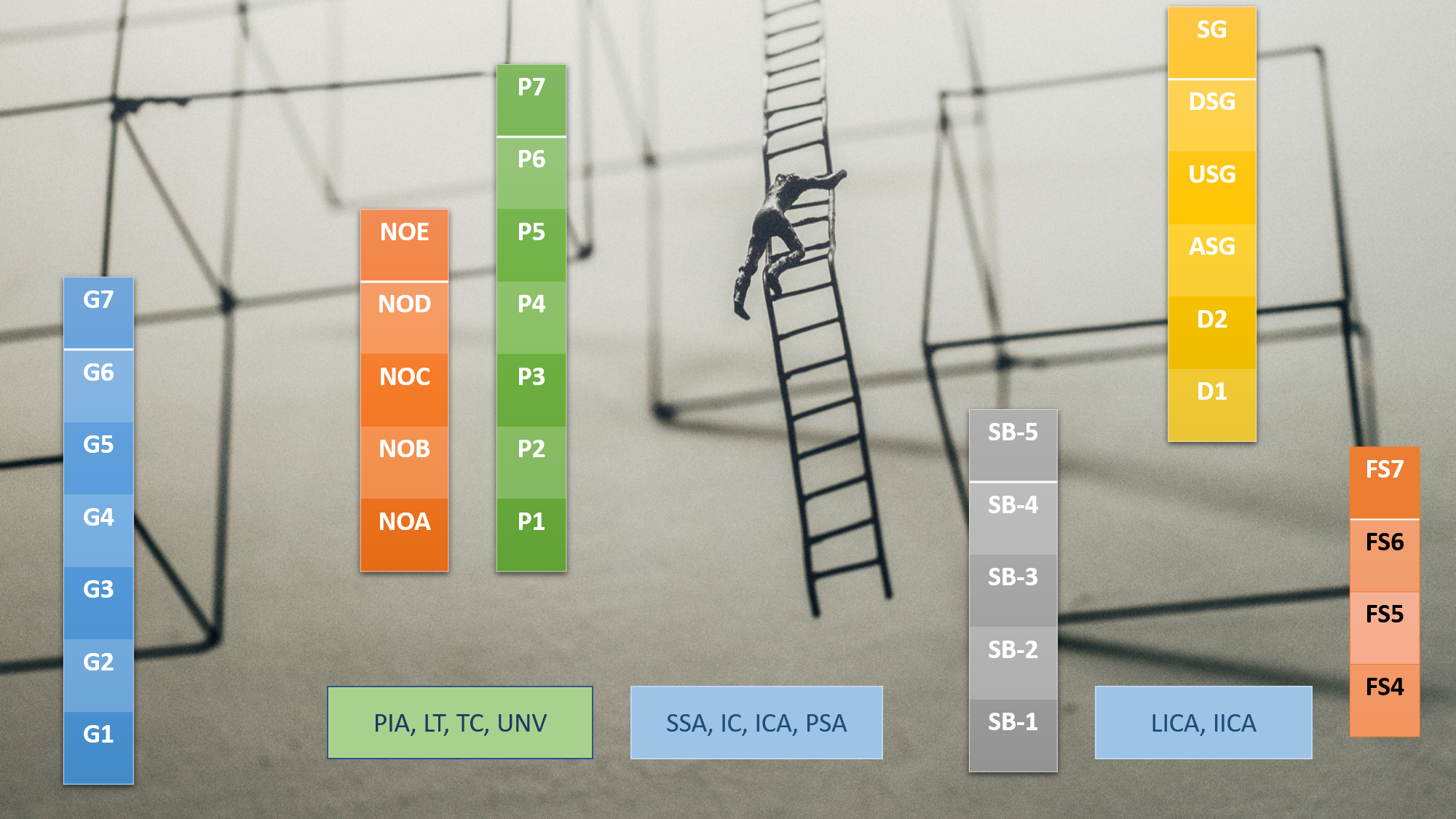
The UN common system. Administered under the authority of the International Civil Service Commission, the common system comprises the United Nations, its affiliated programmes, thirteen specialized agencies and one organization holding special status under the ICSC statute — some thirty entities, from the ILO and WHO to the International Criminal Court.1 It comprises five Professional grades (P-1 to P-5), two Director levels (D-1 and D-2) and the Assistant and Under-Secretary-General levels above them, alongside locally recruited General Service grades and the smaller Field Service and National Professional Officer categories.2 Professional salaries rest on a single worldwide base scale, with post adjustment applied by duty station. The ICSC states plainly that the World Bank Group and the International Monetary Fund “are not part of the common system”.1
The Co-ordinated Organisations. A parallel system, established in 1958, links six intergovernmental bodies: NATO, the OECD, the Council of Europe, the European Space Agency, EUMETSAT and ECMWF. Salaries, allowances and pension provisions are set through shared machinery, the Co-ordinating Committee on Remuneration, and posts are classified in A, B, L and related categories rather than in P and G grades.3 The European Space Agency describes itself as “part of the Co-ordinated Organisation system”, with employment conditions established at that level.4 This family is frequently overlooked, and accounts for a significant share of professional employment in Europe.
The EU institutions. Grades are fixed in law. Article 5 of the Staff Regulations of Officials of the European Union establishes three function groups: Administrators (AD), with “twelve grades, corresponding to managerial, conceptual and analytical” as well as linguistic and scientific duties, numbered AD 5 to AD 16; Assistants (AST), with eleven grades; and Secretaries and Clerks (AST/SC), with six. Contract agents occupy a separate structure of four function groups.5 Entry qualifications are specified by grade band in the same article, which makes the EU system the most codified of the four.
The international financial institutions. Each maintains its own structure. The World Bank Group uses a lettered scale running from GA through GK, published as country-specific net salary scales with a minimum, midpoint and maximum for each grade. The International Monetary Fund distinguishes support staff (grades A01 to A08), professional staff (A09 to A15) and managerial staff (B01 to B05).6 Regional development banks follow their own conventions again: the African Development Bank, for example, classifies professional posts as PL and executive posts as EL.
Why the notation cannot be mapped
Three differences make direct translation unsound, and each is a difference of principle rather than of detail.
The first concerns how pay is set. Professional salaries in the common system are determined under the Noblemaire principle, which holds that the international civil service must be able to recruit from all Member States including the highest paid, and which is applied by reference to the highest-paying national civil service. Locally recruited staff are paid instead according to the “best prevailing conditions of service in the locality”, established through periodic local salary surveys.2 The World Bank Group, by contrast, states that its compensation policy rests on “providing competitive market-based salaries” and rewarding individual performance, with the structure reviewed annually against measured local market movement.7 Two organizations answering to different comparators will not produce comparable ladders, whatever the notation suggests.
The second concerns what a grade contains. In the common system, a grade is a set of incremental steps through which staff advance largely by length of satisfactory service. In the World Bank Group model, a grade is a salary range within which movement depends on annual performance appraisal. Two posts described as equivalent may therefore differ substantially in pay depending only on where each holder sits within the band.
The third concerns the basis on which figures are expressed. Published amounts may be gross or net, before or after internal taxation or staff assessment, and with or without post adjustment, expatriation or dependency allowances. Comparing headline figures across systems without reconciling those conventions produces a result that is not merely imprecise but wrong.
Which way the numbers run
A practical hazard deserves separate mention, because it reverses the meaning of a grade rather than merely shifting it. The direction of numbering is not consistent across systems.
| System | Notation | Direction |
|---|---|---|
| UN common system | P-1 to P-5, then D-1, D-2 | Ascending — higher is more senior |
| EU institutions | AD 5 to AD 16 | Ascending |
| World Bank Group | GA to GK | Ascending, alphabetically |
| IMF | A01 to A15, then B01 to B05 | Ascending, across two series |
| African Development Bank | PL8 to PL1 | Descending — lower is more senior |
A reference to “PL2” therefore denotes a senior management post, while a reference to “AD 5” denotes an entry-level graduate appointment. Confusing the two directions is among the more common errors in cross-institutional comparison, and it appears regularly in secondary sources.
What can legitimately be compared
Three comparisons are defensible, and they are the ones a well-advised candidate or HR practitioner should make instead.
The first is the job itself. Classification systems assess scope, complexity, decision-making authority, budget and staff responsibility, and reporting line — all stated in the vacancy notice, and all comparable across institutions without reference to any grade letter. The ICSC maintains job classification standards for this purpose, and Annex I to the EU Staff Regulations performs the analogous function.
The second is published net remuneration at a specified duty station, expressed on a consistent basis. Every family publishes its scales: the ICSC issues the common-system scales, the World Bank Group its headquarters and country office compensation scales, and the Co-ordinated Organisations theirs. Because revision cycles differ, the comparison holds only between scales in force on the same date.
The third is portability of grade, which is real but strictly bounded. Within the common system, grade genuinely travels: organizations share one classification system and one salary scale, which is what allows movement between agencies without regrading. Outside it, no such recognition exists, and an offer from a different family should be assessed on its own terms — a point developed in the guide to reviewing an offer before signing.
Common mistakes & FAQ
“There is an official equivalence table.” There is not. Tables in circulation are constructed by third parties from salary comparisons or job-title matching, and they carry no institutional standing. They may be a reasonable starting point for orientation; they are not a basis for negotiation.
“The Bretton Woods institutions use UN grades.” They do not, and they are formally outside the common system.1 The same applies to the EU institutions, the Co-ordinated Organisations and the regional development banks.
“A higher salary indicates a higher grade.” Not across systems, and not always within one. Post adjustment varies by duty station, internal taxation regimes differ, and range-based structures allow wide variation at a single grade.
“Grade will be honoured on transfer.” Only within a common system. Elsewhere the receiving organization classifies the post it is filling, not the applicant's history. Prior grade is evidence of scope; it is not an entitlement.
“The published scale is current.” Scales are revised on different cycles and by different mechanisms. Any figure taken from a scale should be checked against the effective date printed on it.
A note on scope
This guide addresses the grade structures of the four principal families of intergovernmental employer. It does not cover international non-governmental organizations, the Red Cross and Red Crescent movement, or non-staff contract modalities, each of which operates on separate arrangements. Because classification, progression and allowance rules are set by each organization and revised periodically, the governing texts are the organization's own staff regulations and published scales, and its human resources office is the authority on any individual case.
Key takeaways
- No official equivalence table exists between the grade systems of different international organizations, and published comparisons are third-party inference.
- Four families account for most intergovernmental employment: the UN common system, the Co-ordinated Organisations, the EU institutions, and the international financial institutions.
- Grade is portable within a family and not between families; outside a common system, the receiving organization classifies the post rather than the person.
- Numbering direction differs between systems, so a low number may denote either the most junior or the most senior level.
- The sound comparison is of job scope and of published net remuneration at a named duty station on scales in force at the same date.
Sources
- International Civil Service Commission, “The UN Common System,” icsc.un.org, accessed August 2026. ↩
- International Civil Service Commission, “Salary Scales,” icsc.un.org, and “United Nations Common System of Salaries, Allowances and Benefits,” ICSC booklet. ↩
- Council of Europe, “Co-ordinating Committee on Remuneration (CCR),” rm.coe.int. ↩
- European Space Agency, “What we offer — salaries and allowances,” esa.int. ↩
- Staff Regulations of Officials of the European Union, Article 5, consolidated text, EUR-Lex. ↩
- World Bank Group net salary scales, published by country, worldbank.org; International Monetary Fund staff salary structure, Annual Report web tables, imf.org. ↩
- World Bank Group Human Resources, “HQ and CO Compensation Scales,” worldbank.org, accessed August 2026. ↩
Related reading
- How to decode the UN grading system (P-1 to D-2) — the classification structure within the common system
- Professional versus General Service grades
- How UN salaries are set: inside the common system
- UN post adjustment explained
- International career paths: from NGO to UN to government
- Negotiating an offer: what is flexible and what is not
Read as internal notation rather than transferable rank, grade becomes a manageable question. The comparison that holds is between the scope of two posts and the remuneration published against them at a named location on a stated date; the comparison that fails is between two letters. Current UN and international vacancies on UNjobnet →
Last reviewed: August 2026. This guide is general information rather than official HR or financial advice — entitlements should be confirmed with the employing organization's HR and the governing UN instructions.