Call for proposal for Baseline Evaluation of the C4RPW Program
International Center for Agriculture Research in the Dry Areas (ICARDA)
Consultancy Close on 20 Mar 2026
About ICARDA
The International Center for Agricultural Research in the Dry Areas (ICARDA) is a treaty-based international non-profit research organization supported by CGIAR. ICARDA’s mission is to reduce poverty, enhance food, water, and nutritional security, as well as environmental health in the face of global challenges including climate change. We do this through innovative science, strategic partnerships, linking research to development and capacity development that consider gender equality and the role of youth in transforming the dry areas. ICARDA works in partnership with governments, universities, civil society, national agricultural research organization, other CGIAR Research Centers, and the private sector. With its temporary Headquarters in Beirut, Lebanon, ICARDA operates in regional and country offices across Africa, Asia and the Middle East. For more information: www.icarda.org.
Program Background
The RPW Program is a three-year international and multi-institutional program designed to combat the Red Palm Weevil (RPW), a devastating pests that threatens date palm, coconut, oil palm cultivation in UAE and LMICS. The program is funded by the Gates Foundation (GF) and The United Arab Emirates’ Presidential Court, and led by ICARDA, the program aims to develop, validate, adopt, and translate innovative, sustainable science-based, cost effective and environmentally friendly solutions to manage and contain RPW infestations. With the United Arab Emirates (UAE) as a test bed for new innovations, the program will develop and establish scalable strategies that can extend to other low- and middle-income countries (LMICs) affected by this invasive pest.
Program goal: The primary goal of the C4RPWC program is to control and contain RPW infestations, thereby improving date palm productivity, profitability and resilience in the UAE and across the broader region. By strengthening scientifically proven, scalable, and sustainable pest management strategies, the program will contribute to enhancing food security, protecting rural and urban livelihoods, and safeguarding environmental ecosystems from the economic and ecological devastation caused by palm weevils.
Overall program objectives: The C4RPWC program leverages the collective expertise of a diverse international consortium, bringing together CGIAR and non-CGIAR international research organizations, alongside UAE government institutions and national partners, as well as their counterparts in targeted LMICs. The consortium will prioritize and lead the development of cutting-edge innovations to control and contain RPW infestations. Moreover, the program will develop a comprehensive national action plan for RPW management, focusing on deployment pathways rather than direct large-scale developmental interventions. By integrating semiochemical, biological agents, new genetic approach, agronomic, citizen science, socioeconomic, and policy tools, the program will generate the scientific and operational framework necessary for a structured and sustainable approach to RPW control.
A critical aspect of the C4RPWC program is the generation and dissemination of knowledge to support evidence-based decision-making. The program will provide decision-makers with critical insights into the current state of RPW infestations, their causes and sources, and the effectiveness of different prevention and mitigation measures. This information will allow for the refinement of intervention strategies, ensuring that proposed control measures are targeted, adaptable, and feasible. To ensure that the innovation and knowledge generated reaches all relevant stakeholders, the program will implement a comprehensive dissemination strategy. The program is structured into 5 interlinked workstreams.
Workstream 1: Climate-resilient, bio-based management of RPW
This workstream, led by the International Centre for Insect Physiology and Ecology (icipe), focuses on leveraging natural ecological interactions to develop bio-based control solutions for the Red Palm Weevil (RPW). The primary strategies include new pheromone-based attract-and-kill systems, nano based biopesticides derived from locally adapted entomopathogenic fungi, RNA interference (RNAi) to disrupt RPW gene expression, and exploration of natural enemies as biological control agents. These solutions aim to reduce reliance on chemical pesticides and improve long-term pest management by providing sustainable, eco-friendly pest management strategy.
Workstream 2: Biotechnological innovations for sustainable RPW control
Led by the International Institute of Tropical Agriculture (IITA), this workstream harnesses cutting-edge biotechnological tools to develop innovative pest control strategies. Key approaches include RNAi as biopesticides, genome editing to enhance date palm resistance, and plant-expressed dsRNA to disrupt RPW gene expression. These next-generation tools aim to introduce highly targeted and sustainable interventions, reducing economic losses while minimizing environmental risks together with other conventional IPM tactics.
Workstream 3: Digital innovation and big data analytics
The International Crops Research Institute for the Semi-Arid Tropics (ICRISAT) leads this workstream, which applies AI, machine learning, and digital sensing technologies to create a proactive and data-driven RPW management system. The focus is on early detection tools like thermal imaging and remote sensing, predictive analytics using machine learning, and integrating IoT sensors and drones for targeted palm weevil management. This workstream aims to transform RPW management from reactive to predictive, providing real-time insights to optimize effectiveness of other innovations in pest control strategies.
Workstream 4: Good Agricultural Practices for RPW management
Led by the International Center for Biosaline Agriculture (ICBA), this workstream integrates agronomic and ecological innovations to enhance the resilience of date palm production systems through improving palm tree health as first line of defense of protecting the crop. Key practices include smart irrigation systems, improved sanitation measures, evaluating the impact of date palm variety and environmental stressors, and deploying pest-free seedlings. By embedding science-driven best agricultural practices, this workstream aims to foster long-term resilience and protect palm crops from RPW and other pest threats.
Workstream 5: Translate research to action - pathways to scaling
Led by ICARDA, has three wok packages and focuses on adaptive research and conceptualizing deployment pathways to ensure that innovations can be effectively translated into real-farm impacts. The three work packages are designed in developing adoption pathways and scaling strategies, engaging in citizen science and community engagement, and conducting socioeconomic impact assessments. This workstream ensures that the program delivers locally adapted, socially inclusive, and economically viable RPW management solutions, establishing a foundation for sustainable, long-term national strategies.
The Program also has embedded cross-cutting work areas, namely: Capacity development; Monitoring, Evaluation and Learning (MEL) and Communication.
Implementing Partners
1. The International Center for Agricultural Research in the Dry Areas (ICARDA) is leading and coordinating all research workstreams and cross-cutting areas such as capacity development and Monitoring, Evaluation, and Learning (MEL). ICARDA is also leading the Pathways to Scale workstream, overseeing research and coordination efforts for RPW management technologies, and piloting implementation and scaling pathways. This includes developing a regulatory framework for RPW quarantine systems and conducting socioeconomic surveys and impact assessments. ICARDA aims to empower local stakeholders through citizen science and capacity-building activities to ensure the widespread adoption of sustainable RPW control measures.
2. TheInternational Centre for Insect Physiology and Ecology (icipe) leads the Semiochemical and Biological Innovations workstream, focusing on pheromone-based approaches and biopesticides for RPW control. They will also explore natural enemies to enhance integrated RPW management technologies.
3. The International Institute of Tropical Agriculture (IITA) leads the Biotechnological Innovations workstream, advancing RNA interference (RNAi)-based approaches and genetic editing of date palms for RPW management.
4. The International Crops Research for the Semi-Arid Tropics (ICRISAT) leads the Digital Innovations and Data Analytics workstream, developing acoustic, optical, thermal, and imaging tools for RPW management. They will also create predictive models and spatial risk maps for RPW spread using advanced data analytics and AI/ML.
5. The International Center for Biosaline Agriculture (ICBA) leads the development and implementation of new Good Agricultural Practices (GAP) for RPW management. They focus on improving production under saline and desert conditions, testing various pest management methods like fertilization, smart irrigation, roles of habitat fragmentation in RPW managnet, and establishing certification protocols for disease- and pest-free date palm seedlings. ICBA will also enhance stakeholder participation and community involvement in RPW management together with WS5.
Purpose of the Request for Proposals
The purpose of this request for Proposals (RfP) is to conduct a baseline evaluation of the C4RPW Program. The specific objectives of the evaluation are to:
(i) Determine/validate the status of the Program’s intended research outcome (and outputs) at baseline, that is, determine the extent to which proposed innovations are integrated in the strategies policies and programs of national /regional public and private institutions, or the lack thereof.
(ii) Determine if the proposed innovations are consistent with the national agrifood policies of the UAE and LMICs.
(iii) Examine whether the Program design, including collaborative implementation arrangements and associated budget allocations, is/are appropriate to meet the program objectives and ensure effectiveness and efficiency.
(iv) Examine the potential of the Program to contribute to broader agrifood systems through advancement of innovations that mange pests closely related to the RPW, and crops closely related to the date palm.
(v) Determine the extent to which program management has developed partnership with the entities highlighted in the proposal and other relevant entities, or how they can be enhanced.
(vi) Determine if there are foreseeable opportunities and threats to the translation of the research workstream output into the envisioned research and development outcomes; and how the program can cease identified opportunities and avoid the threats.
(vii) Appraise the program MEL Plan and associated tools, including recommendation of approaches to measure or credibly predict the contribution of the Program to development outcomes and associated returns-on-investment.
Methodology
The evaluator(s) are required to propose methods that provide an objective and holistic understanding of the baseline scenario, with regards to the objectives stated above. The approaches may include the use of either secondary data/literature review or primary data collection or both. The evaluator(s) must demonstrate that the baseline study is representative of the program thematic scope (workstreams) and locations (UAE and LMICs) to ensure that the resultant findings are generalizable.
Reporting and Communication
The evaluator(s) will report to the ICARDA Monitoring, Evaluation and Learning (MEL) Research Team Leader. The evaluators will provide regular updates on the progress of the evaluation through regular meetings, presentations and emails.
Technical bid evaluation Criteria
The following criteria will be the basis of the selection of the successful bidder:
a) Academic Qualifications and Skill Set (20%)
(i) Evaluation team members must hold PhDs and Masters qualifications that closely relate to the work of the Program workstreams, including, but not limited to: Monitoring and Evaluation (M&E), Program/Project Management, Agro-forestry, Urban Entomology, Agricultural Economics, Agriculture (with a focus on integrated Pest Management of tree crops) or other disciplines related to the thematic scope of the C4RPW program.
(ii) Skill sets: Demonstrated strong data management and analysis skills, proficiency in the use of digital data collection and visualization tools; expertise in conducting gender and social inclusion studies, Fluency in written and spoken English and Arabic is required.
b) Relevant Experience in M&E Evaluations (30%)
(i) Experience implementing baseline, mid-term and endline evaluations
(ii) Experience working or evaluating Integrated Pest Management (IPM) programs in palm-based production systems is preferred
(iii) Experience working in or multi-country evaluations in the broader Middle East and North Africa (MENA) and Gulf regions, including Lower Middle-Income Countries (LMICs) in SSA/SA.
(iv) Experience leading or co-leading evaluation teams that have developed recommendations that have been adopted by research and development organizations in invasive pest management.
(v) Track record of writing detailed and yet concise evaluation reports.
d) Methodology (50%)
(i) Clear use of an evaluation design matrix that is responsive to the CGIAR evaluation criteria.
(ii) Clear, practical, robust, logical and complementary methodological approaches are desired, including approaches for data triangulation/validation where applicable.
(iii) Clear, justifiable and representative selection of field visit sites and/or respondents.
(iv) Strong alignment to and interpretation of the RfP.
(v) Insight by the consultant(s) by commenting objectively on the ToR/RfP.
(vi) Elaborate suggestions on tools to be used for capturing/recording data, data transmission, data monitoring, data analysis, and visualization.
(vii) Conformity to ethical research approaches since the evaluation involves human subjects. Demonstrated knowledge of requirements and procedures of local research ethics boards will be advantageous.
(viii) Clear work plan in line with the RfP, and justification of deviations.
(ix) Potential risks to the evaluation process and associated risk mitigation measures.
Financial bid evaluation considerations
The best financial bids will be those that demonstrate value-for-money and whose budget in closely tied to the rationally determined methodological approach, justifiable cost items and remuneration rates. Thus, ICARDA will not be obliged to give the highest rating to the lowest priced bid.
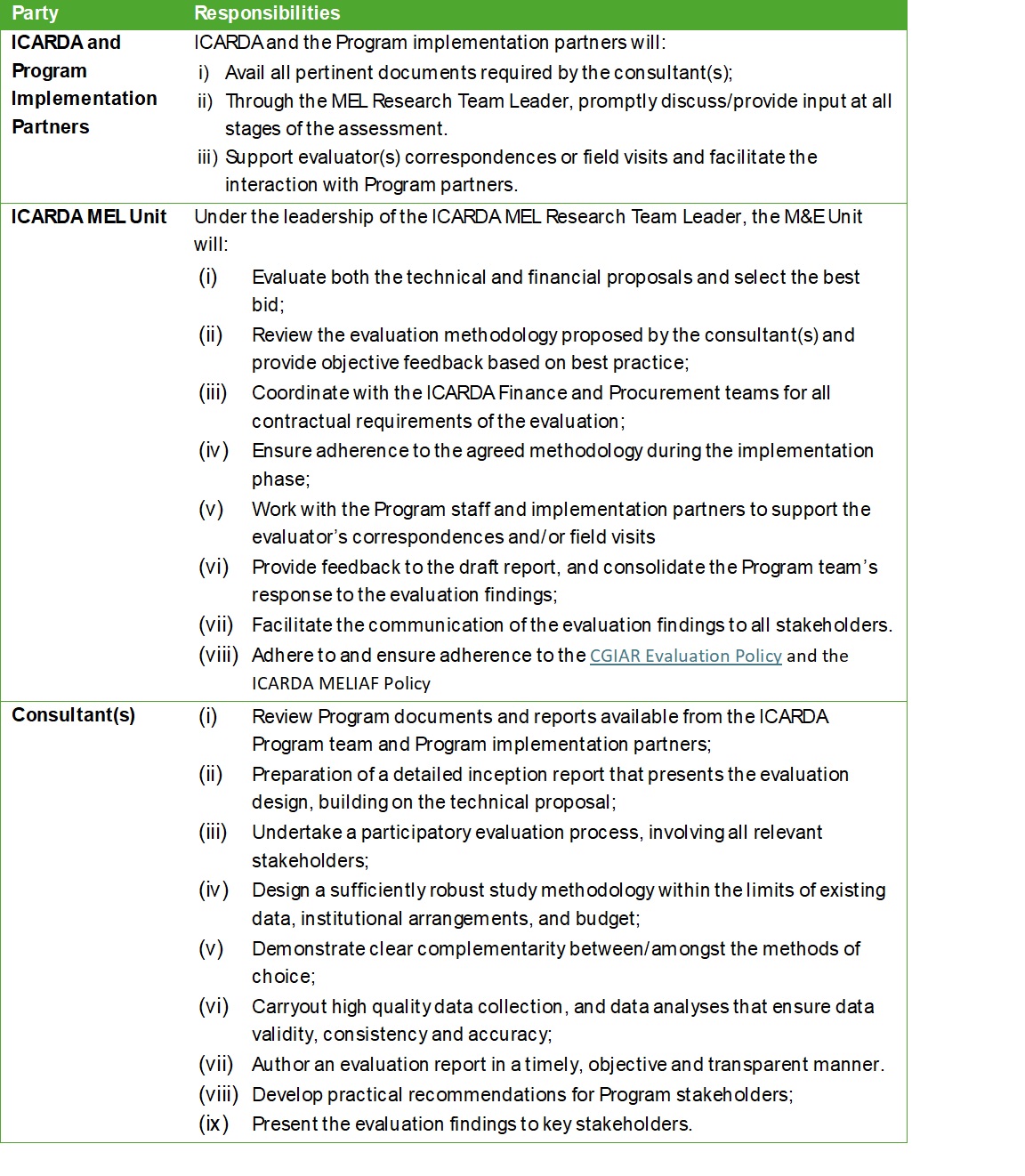
Roles and Responsibilities
Evaluation Timeline and Deliverables
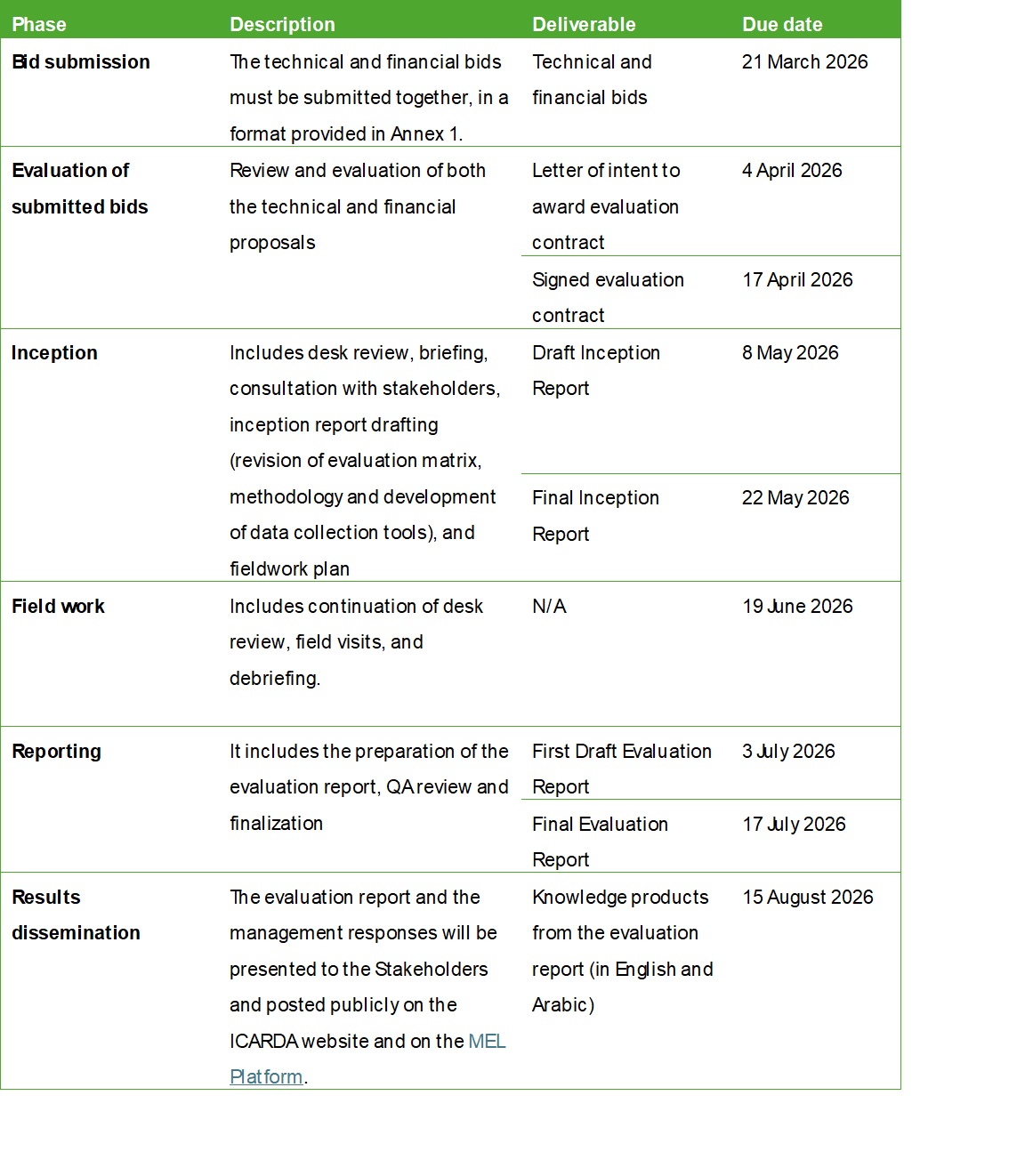
The evaluation assignment is to be completed by 30 June 2026. The tentative schedule for the evaluation with estimated timelines and deliverables is presented below.
Additional Information
The following additional documents will be provided upon request by e-mail addressed to: ICARDA-MEL@cgiar.org
Part 1: Technical Proposal
1.1 Interpretation and comments to the RFP (1 page max)
1.2 Proposed Methodology (5 pages max)
Clearly elaborate the research methods and justification
Include an evaluation design matrix: Include evaluation criteria, evaluation questions, sub-questions and/or indicators, data collection methods, data sources, data collection instruments, methods for data analysis
1.3 Work plan (1 page)
1.4 Composition of team and tasks and time schedule of each team member (1 page)
1.5 Firm’s Profile and Relevant past experience (applicable only to a corporate entity) (3 page max)
Part 2: Financial Proposal
Lump sum price (in USD)
Breakdown of Lump Sum Price, showing all costs for the evaluation, broken down into fees and reimbursable.
Annex 1: CVs of proposed team members
Annex 2: Reference letters and referee contact details
Requirements
Benefits