You've found a promising UN job posting, but the listing says "P-3 level" and you're not sure whether you qualify — or even what it means for your salary and career prospects. The UN grading system can feel like insider code, but once you understand the logic, it becomes a powerful map for navigating your international career.
The Two Main Staff Categories
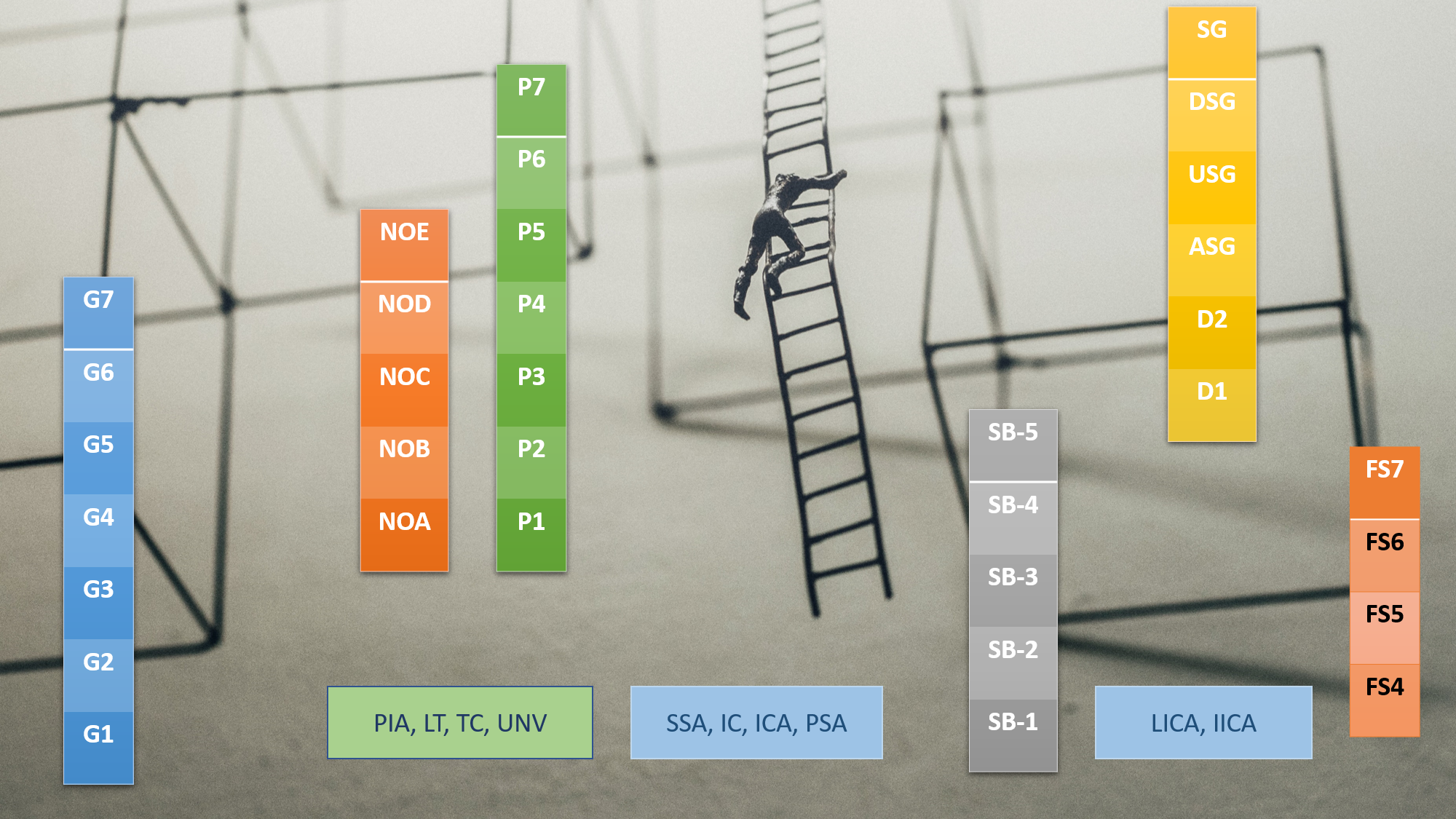
The UN organizes its workforce into two broad categories: General Service (G) and Professional and above (P/D). These differ in how staff are recruited, what roles they fill, and how salaries are determined.
- General Service (G-1 to G-7): Locally recruited staff in administrative, clerical, and technical support roles. Salaries are set through local labor market surveys at each duty station. A G-5 hired in New York has a contract tied to that city — you don't automatically transfer to Geneva at the same grade.
- Professional (P-1 to P-5): Internationally recruited staff, typically with university degrees and specialized expertise. Salaries follow a single global scale — a P-3 in Nairobi earns the same base pay as a P-3 in Geneva (post adjustment varies, but the base is identical).
- Director (D-1, D-2): Senior leaders managing large programs, departments, or country offices.
- Senior Leadership (ASG, USG): Assistant Secretary-General and Under Secretary-General — appointed at the highest levels, not recruited through standard job postings.
The Professional Grades Up Close: P-1 Through P-5
This is where most aspiring UN professionals focus. Each P-grade represents a distinct career stage with clear experience expectations:
- P-1: Rarely advertised. Usually reserved for highly specialized entry-level roles or specific fellowship programs. Requires a first degree and 1–2 years of relevant experience.
- P-2: The standard entry-level professional grade. Typically requires a master's degree plus 2 years of relevant experience, or a bachelor's with 4 years. Many competitive entry programs — the Young Professionals Programme (YPP) and Junior Professional Officer (JPO) schemes — place candidates here.
- P-3: Mid-level and the most widely advertised grade. Usually requires 5–7 years of progressively responsible experience. Many professionals spend the longest stretch of their UN career at P-3 before advancing.
- P-4: Senior professional. Typically 7–10 or more years of experience. You're expected to manage teams, lead programs, and represent the organization. Vacancies at this level are hotly contested.
- P-5: The ceiling of the professional ladder. Requires 10–15 years of experience and a demonstrated track record of leadership in the UN system or an equivalent international environment.
Steps Within a Grade
Within each grade there are up to 13 steps. When you join the UN, HR reviews your prior qualifying experience and may grant up to 3 steps of credit above Step 1. After joining, you advance one step per year automatically — this is the within-grade increment.
This means two colleagues at P-3 may earn noticeably different salaries: a P-3 at Step 7 earns more than one at Step 1. It also means the top of a lower grade can overlap with the bottom of the next — a P-3 at Step 13 may earn close to a P-4 at Step 1. That overlap is intentional, rewarding experience and loyalty without forcing premature promotion.
National Professional Officers: A Third Path
NPO positions (graded NO-A through NO-E) are locally recruited but do professional-level work. Unlike G-staff, NPOs typically hold advanced degrees and are nationals of the host country. If you're a citizen of a country where a UN agency operates, NPO roles can be a lower-competition entry point into professional UN work — and a stepping stone toward an internationally recruited P-grade post.
How Grade Affects More Than Salary
Your grade shapes your entire UN experience beyond your paycheck:
- Travel entitlements: Higher grades qualify for business class on long-haul flights
- Relocation grant: The amount paid to move your household scales with grade
- Education grant: Internationally recruited P-grade staff receive an annual grant toward their children's schooling costs, with amounts that vary by duty station
- Home leave: P and D-grade staff posted internationally qualify for funded home leave travel every two years
- Pension: Both you and the organization contribute to the UNJSPF based on your pensionable remuneration, which is tied to your grade and step
Key Takeaways
- G-grades are locally recruited and location-tied; P-grades follow a global salary scale and are internationally recruited
- P-2 is the standard professional entry point; P-3 is the most advertised and competitive grade
- Steps within a grade accumulate annually — you won't necessarily start at Step 1, and higher steps mean meaningfully higher pay
- Your grade affects travel class, relocation benefits, education grants, and pension contributions — not just salary
- NPO positions are an underused entry route for nationals of UN program countries
Understanding the grading system transforms how you search for opportunities. Instead of applying broadly, you can target the grade that matches your experience, set realistic salary expectations, and plan your progression with clarity. Ready to find roles at your level? Search UN and international jobs on UNjobnet →